Building Blocks
Atoms, electrons, and bonding, ending at water's bent geometry and the hydrogen-bond network that gives water almost every property that matters.
Chapter guide Objectives and section map
- Atoms, electrons, and valence shells
- Ionic vs. covalent bonding
- Water’s geometry and the Hydrogen-Bond Network
- The mole and dimensional analysis (Engineering Notes)
1.1Chemistry
I hated high school chemistry.
Memorizing a grid of elements that felt entirely disconnected from reality. Learning rules that always seemed to have exceptions. Balancing chemical equations that felt like nothing more than math homework in a lab coat. Chemistry was boring, it was rigid, it felt completely dead.
The only reprieve from monotonous formulas came on certain Tuesdays.
Tuesdays were lab days, and the best ones always started with Bunsen burners out on the countertops. I loved sparking the striker and watching the roaring blue flame leap from the countertop. I loved the smell of the gas, the clatter of glassware, and the slight possibility that something might go wrong. And I really loved when we got to blow things up.
I still remember holding a silver strip of magnesium ribbon with a pair of metal tongs and lowering it into the flame. Within seconds it ignited into a blinding white flare, leaving behind nothing but a crumbly heap of white ash. Another week used a battery to run electricity through water, splitting it into pockets of gas, trapping hydrogen in an upside-down test tube. As we tilted that tube over the flame, it ignited a small explosion and unmistakable pop.
For a teenager, that was the good stuff. But I assumed those moments were just flashy exceptions to the otherwise dull work of chemistry. What I failed to see was that the excruciating memorization and exploding magnesium were actually the same subject. The grid on the wall was precisely the reason the ribbon burned white.
Nobody ever told me that. Nobody ever told me what chemistry was for.
Chemistry started to matter to me when I started caring about water. Growing up in the arid Southwest, water has always been an existential concern. We talk about how much snowpack we received, what levels the reservoirs are at, how many more years the aquifers might last. Water scarcity is part of the landscape.
But for most people, the problem remains abstract. They do not see the water circulating through factories, vaporizing to produce electricity, and carrying heat away from hospitals. Each of these systems is vital to modern life, and all of them depend on what is hidden in the water – dissolved, invisible, and waiting.
That is what chemistry is for.
Chemistry did not come alive for me because I learned to enjoy memorization. It came alive because water gave the rules purpose.
It lets us solve problems that no one can see.
1.2Through the Looking Glass
On my desk sits a cup of coffee, a stack of notes, and an eight-ounce glass of water.
Every so often, my attention drifts away from the page and toward the hidden world inside that glass. I pause, stare, and try to imagine what is actually happening in there. I've worked out that this glass contains about 8 × 10²⁴ molecules of H₂O. More than the number of stars in the observable universe.
Light passes effortlessly through the glass, giving the impression of nothing more than a clear, still liquid. But beneath the surface, the atomic world is incessantly and relentlessly in motion. Water molecules rotating, vibrating, and colliding billions of times per second.
Amid all this chaos, water is also doing something magnificent.
Something that almost no other liquid can do.
Individual water molecules are forming links with their neighbors, driven by persistent intermolecular attraction. These singular bonds are constantly breaking, reforming, and reorganizing, but together they create a dynamic network that organizes as a cohesive whole.
Even still water is never truly at rest.
And it is never just water.
The same persistent attractions linking neighboring water molecules have also surrounded and hidden a list of passengers. Based on the latest Consumer Confidence Report, this glass also contains around 2 × 10²⁰ calcium ions, 1.3 × 10²⁰ sodium and chloride ions, and 3 × 10¹⁹ magnesium ions. It is also carrying roughly 4 × 10¹⁹ molecules of dissolved oxygen and countless microscopic bacteria that survived the treatment process.
None of it is doing anything I can see. The water just sits there, giving no indication of what it carries.
But every passenger in that glass is waiting.
Give the calcium a hot surface and it will leave the water as scale, a stony crust that chokes heat transfer and can shut down a boiler. Give the dissolved oxygen a length of steel pipe and it will begin pulling electrons out of the metal, one atom at a time, until the wall gives way. Give the bacteria warmth, stillness, and nutrients over a few quiet days, and they will settle onto the surfaces, build shelter, and turn an ordinary water system into a reservoir for the kind of life that puts people in the hospital.
Nothing in the glass announces any of this.
Water’s ordinariness is the trap.
It is why facility managers underestimate water chemistry. It is why my parents still struggle to explain what I do for a living. It is why water looks simple, until it isn't. A tube plugs. A pipe leaks. A chiller seizes. Suddenly there is far more to water than anyone bothered to see.
The atomic reality is overwhelming. It turns a simple glass of water into an incomprehensible swarm of atoms, molecules, and particles in motion. But fortunately, atoms are remarkably well behaved. What is true of one atom is true of a trillion. We don't have to account for 8 × 10²⁴ individual water molecules and countless dissolved ions. We only have to understand the rules they obey.
The first step is understanding the atom.
1.3Inside the Atom
Chemistry happens because atoms make it happen.
Every bond formed, every crystal precipitated, every flake of rust and every grain of scale is the result of atoms pursuing something. To understand what they want, and why water is so good at giving it to them, we need to look at the three particles that make up an atom: protons, neutrons, and electrons.
Protons: The Identity of Matter
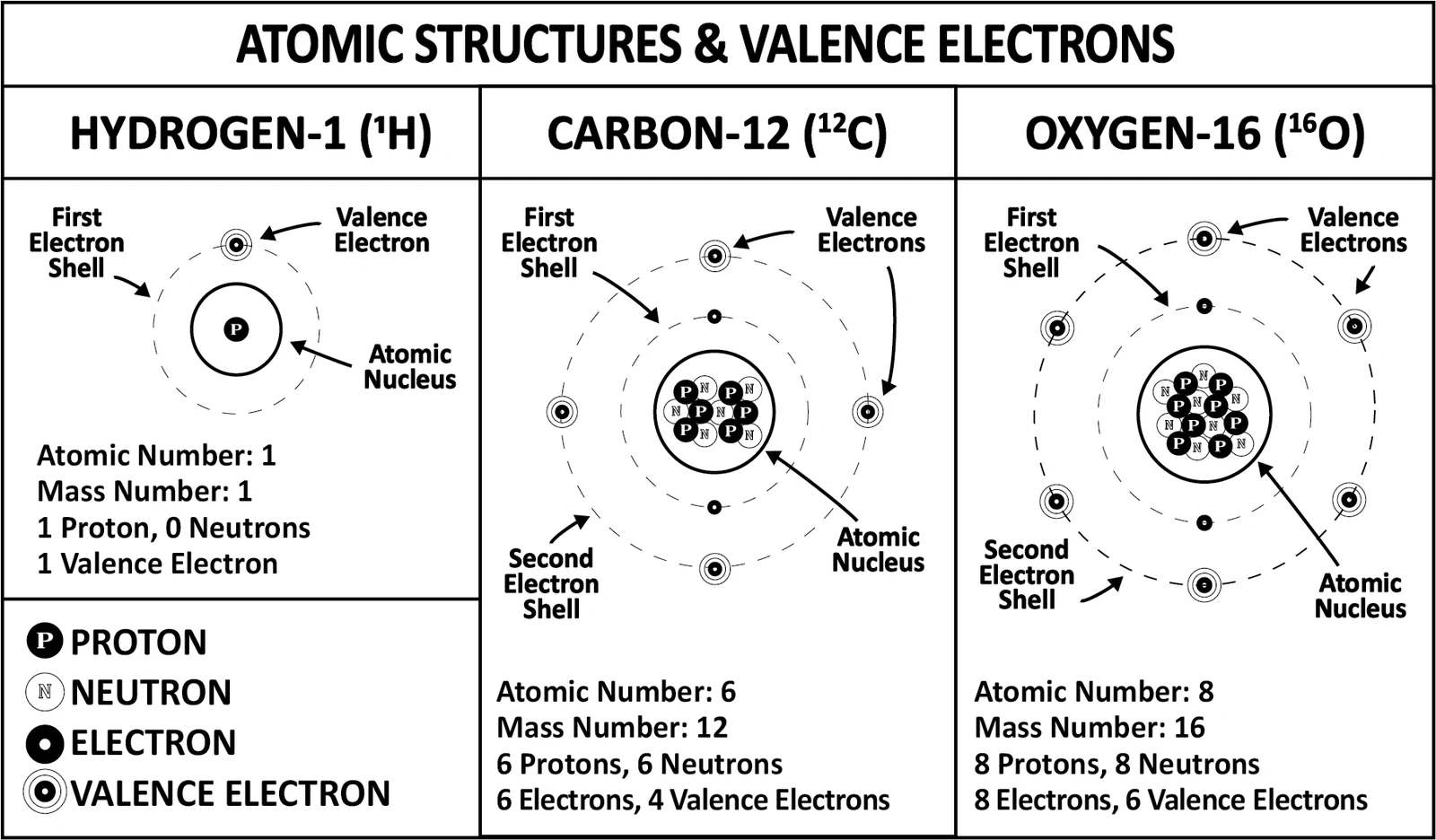
Protons are positively charged particles packed into the nucleus, and they answer the most basic question you can ask about an atom: what is it?
The number of protons is the atom's identity.
One proton makes hydrogen.
Six make carbon.
Eight make oxygen.
Change that number and you don't get a modified version of the same element – you get a different element entirely. But don’t worry, you won’t ever change the number of protons. Outside of stars and nuclear reactors, their arrangement is remarkably stable. We get the atoms we get.
Their permanence is the bedrock everything rests on. It’s what allows the periodic table to exist at all. It’s what guarantees that oxygen stays oxygen, whether it’s dissolved in your glass, bound in scale, or making rust out of steel.
Protons define the atom. They don’t move it.
Neutrons: The Stabilizers
As elements become heavier, more protons get packed into the nucleus. These positive charges, crammed into an impossibly small space, create an intense repulsive force that must be offset for the nucleus to remain intact.
That stabilizing role is played by neutrons.
Neutrons carry no charge and reside in the nucleus with the protons. Their number can change without altering the atom's identity or behavior, variants called isotopes. Carbon-12 and Carbon-14 are both carbon; six protons each, different neutron counts, identical behavior.
Neutrons hold the nucleus together. In ordinary chemistry, they don’t do much else.
Electrons: The Promiscuous
Everything protons and neutrons can't explain, electrons can.
These negatively charged particles exist outside the nucleus. In a neutral atom, the number of electrons matches the number of protons exactly: one negative charge for every positive one, perfectly balanced. Hydrogen carries one. Carbon carries six. Oxygen carries eight.
Unlike protons and neutrons, electrons are not fixed. They move. They rearrange. They are shared between atoms, transferred outright, and distorted by their surroundings.
These movements explain it all.
Electrons determine how atoms bond, dissolve, precipitate, and react. They decide whether metal remains intact or turns to rust, whether ions stay dissolved or assemble into scale, and whether a system remains stable or quietly drifts toward failure.
But not all electrons are equal when it comes to these decisions. To understand which ones actually matter, we have to look at where they’re known to hang out.
1.4Valence Electrons
Electrons aren’t just floating freely around the nucleus.
They are drawn toward it, attracted by oppositely charged protons. They pack in as close as physics will allow, but their arrangement is limited to defined energy levels, or “shells.” Each shell can only hold a certain number of electrons at once, and once they are full the next electrons are forced to stack outward into the next higher level.
Each new shell sits farther from the nucleus and holds its electrons at a higher energy than the one before it. Electrons in higher shells are farther from the nucleus and shielded by the electrons beneath them. As a result, the outer electrons are generally held less tightly and are more available for chemical reactions.
The most stable an atom can be, its lowest possible energy, is when its outermost shell is completely filled. This symmetry leaves the atom in its lowest-energy state, with no available slot to fill and little reason to react.
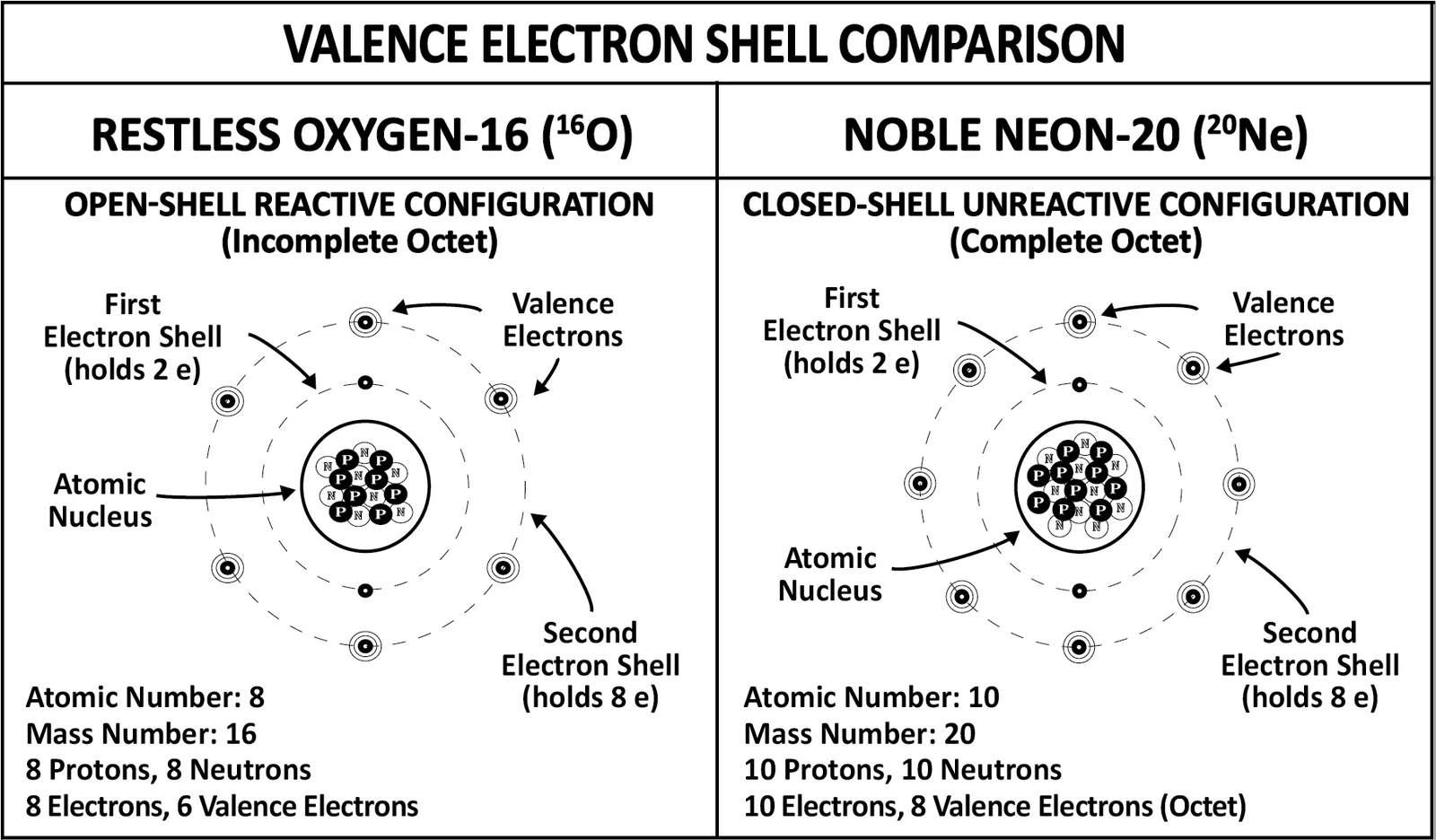
The first shell is filled up by just two electrons. For the main-group elements most relevant to water chemistry, the outer shell is generally most stable when it contains eight valence electrons, a pattern known as the Octet Rule.
Noble gases, sitting at the far-right side of the periodic table, have complete valence shells. Neon, for example, has ten protons and ten electrons. Two of the electrons occupy and fill the first electron shell, while the remaining eight electrons occupy and completely fill the outer valence shell (complete octet). Noble gases have their electrons arranged exactly where they want them, and as a result they are – chemically speaking – at rest. How very noble of them.
Everyone else is restless.
The problem is that most neutral elements don’t have filled outer shells. Oxygen, for example, has eight protons and eight electrons. Like neon, two of the electrons occupy and fill the first electron shell. But that leaves only six electrons in the outer valence shell, two electrons shy of a stable octet. This leaves oxygen, and every other non-noble-gas element, with an incomplete outer shell and something to gain by bonding with another atom.
These atoms do not tolerate that imbalance for long.
When unsatisfied atoms meet, the inner shells never touch. Those electrons stay put. Only the electrons in the outermost shell, called valence electrons, participate in chemistry.
To lower their energy, atoms bond, share, steal, or surrender their valence electrons. All in pursuit of a filled outer shell. Transition metals such as iron and copper are more complicated, but the same underlying principle remains: reactions occur when electrons can move into a lower-energy arrangement.
This relentless drive toward stability is the engine of chemistry.
It is also why almost nothing in nature exists as a lone atom. An unfilled shell is an open invitation. Sooner or later, a restless atom finds another, and they do something about it.
1.5Bonding
Most atoms bond.
This is not romance. It is a solution to an energy problem.
Atoms bond because the resulting arrangement of electrons places them at a lower total energy. The elements themselves do not change as their protons remain fixed. What changes, constantly, is the arrangement of electrons. These restless particles transfer, share, and redistribute themselves in pursuit of filled valence shells.
In water chemistry, atoms achieve this in two primary ways: by transferring electrons outright, or by sharing them cooperatively.
These strategies are known as ionic bonding and covalent bonding.
Ionic Bonds: The Transfer
Ionic compounds form when electrons are transferred from one atom to another, creating oppositely charged ions that attract to form ionic bonds.
Sodium chloride, or table salt, is a classic example. Sodium has one valence electron, placing it in a high-energy state. Chlorine has seven valence electrons, one shy of a stable octet. Neither atom is satisfied.
To resolve this imbalance, sodium donates its lone valence electron. In doing so, it now has more protons than electrons and becomes a positively charged ion, or cation (Na⁺). Chlorine accepts the electron, gaining more electrons than protons and becoming a negatively charged ion, or anion (Cl⁻). We now refer to it as chloride, signaling that it has been ionized.
Both ions have happily achieved stable outer shells. And then, just like magnets, the positively charged sodium and negatively charged chloride are drawn together. Their electrostatic attraction forms an ionic bond.
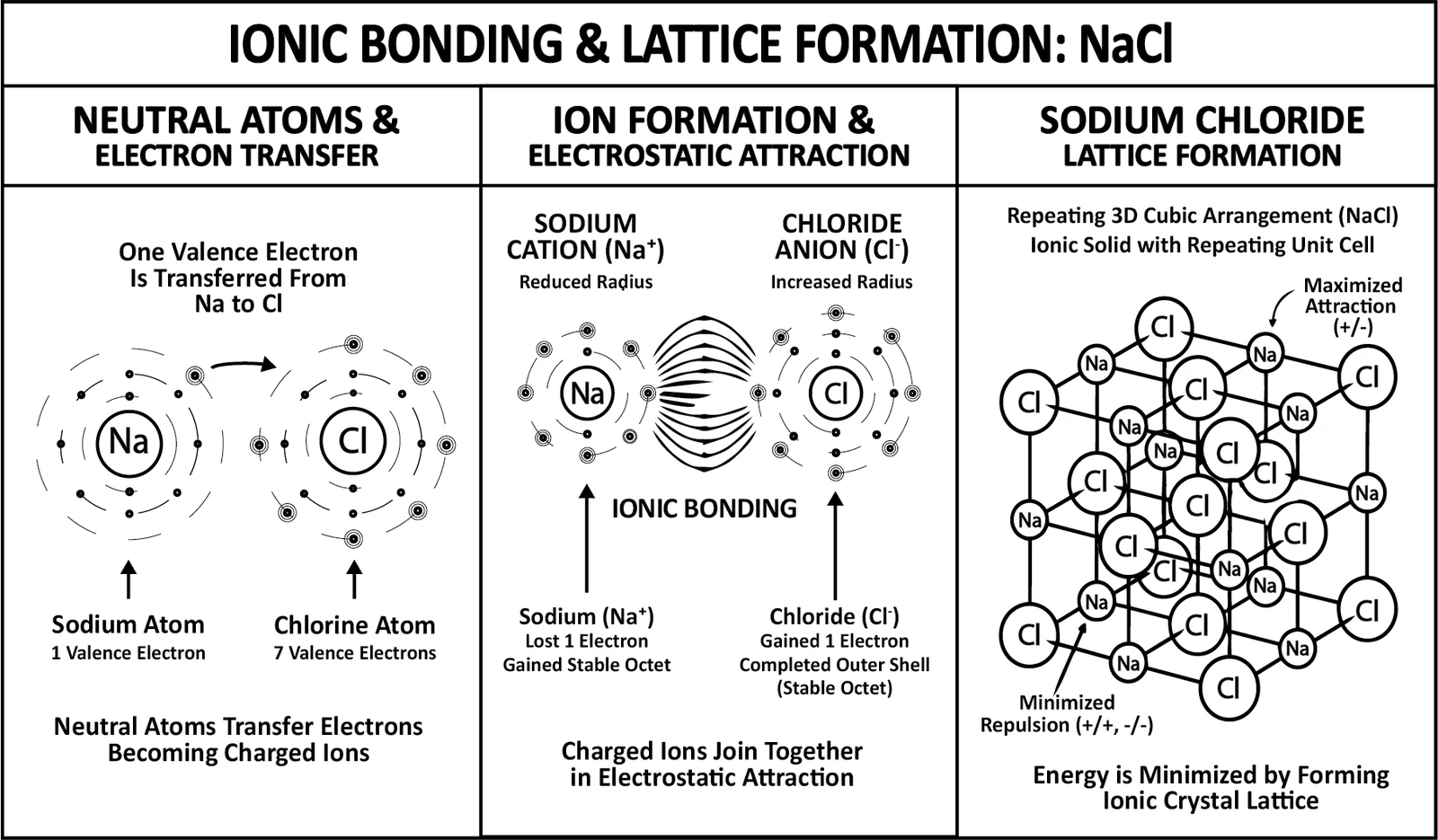
When more sodium and chloride are added to the mix, the ions can assemble into a repeating, three-dimensional crystal lattice, held together by electrostatic forces. This highly ordered arrangement maximizes electrostatic attractions between oppositely charged ions (+/-), and minimizes repulsion between like-charged ions (+/+ : -/-). The resulting solid is more stable and energetically favorable than individual pairs of ions.
Ionic solids are strong, but they have a weakness. The same exposed charges that hold the lattice together also make it a target. Water can disrupt that arrangement by surrounding and stabilizing the individual ions, dissolving the lattice.
Covalent Bonds: The Share
Covalent bonds form when electrons are shared between atoms.
This usually occurs between non-metal elements, which hold their electrons tightly. Their nuclear charge and compact atomic radius give them a strong pull on nearby electrons, which resists giving electrons up entirely. This property is called electronegativity.
Covalent bonding is the compromise: instead of transferring electrons outright, these atoms share them, so that each can move toward a more stable valence configuration. The shared electrons act as a bridge between the atoms, making the bonded arrangement more stable than the separated one.
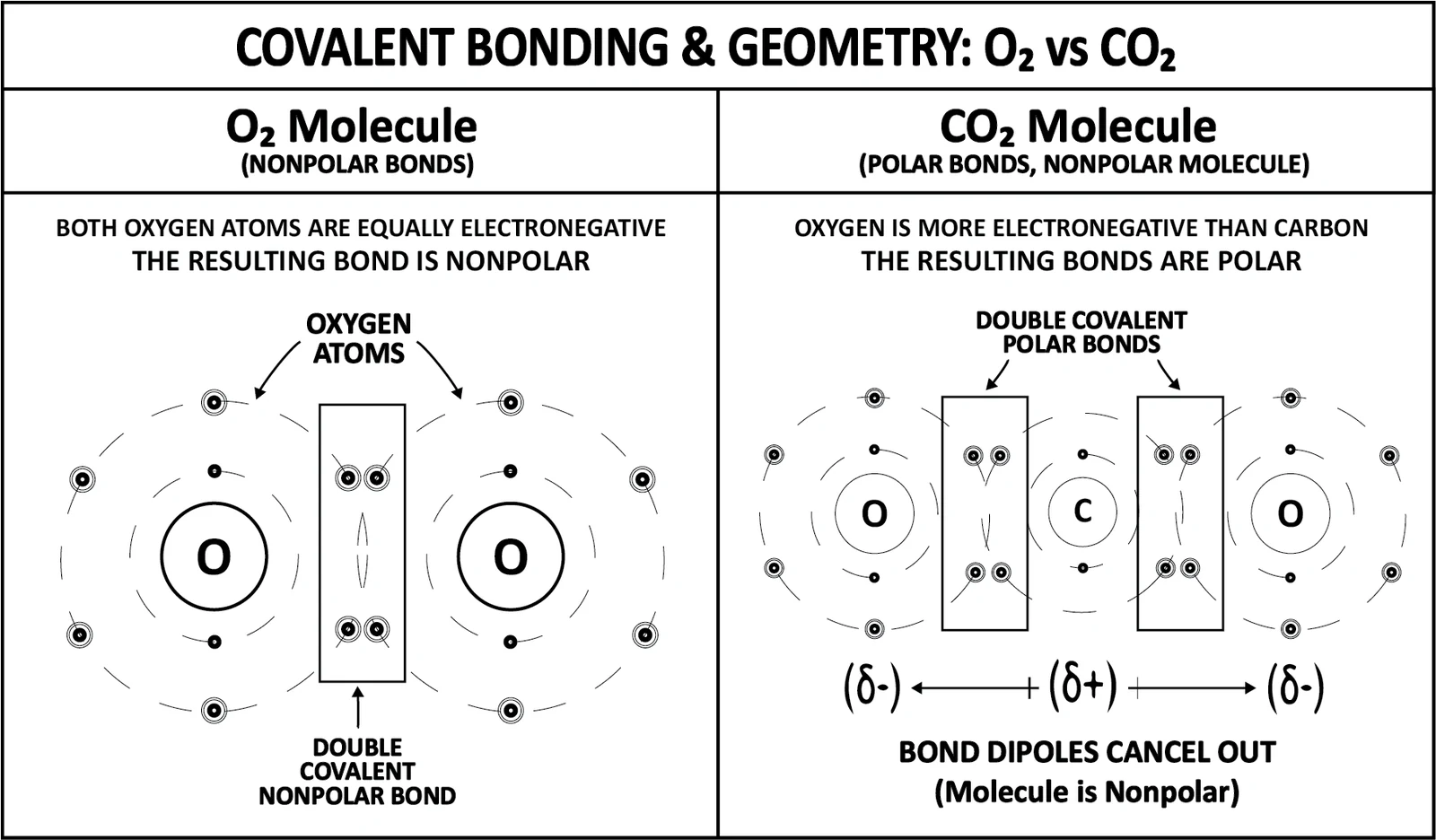
When identical atoms bond, like the two oxygens in O₂, they share electrons equally because their electronegativities are the same. Each oxygen atom needs two additional electrons, so they form a double bond: two shared pairs, four electrons total. The pull is symmetric. The bond is nonpolar.
But covalent bonds do not only form between identical atoms.
Some of the most important molecules in water treatment are formed by covalent bonds between different elements. When atoms with different electronegativities bond, such as carbon and oxygen in CO₂, the shared electrons are pulled unevenly. Oxygen, being more electronegative, holds the electrons closer, creating a polar covalent bond. The oxygen end carries a partial negative charge. The carbon end carries a partial positive charge.
This distinction matters.
Polar bonds cause molecules to interact with water in unique ways. However, a polar bond does not automatically create a polar molecule.
Molecular polarity depends on geometry.
In carbon dioxide, each carbon–oxygen bond is polar, but the molecule is linear. The opposing charge imbalances point in opposite directions and cancel each other out.
The bond is polar. The molecule is not.
Covalent bonding underlies many of the most important molecules in water treatment:
-
hydrogen bonds with itself (H₂) and with oxygen (H₂O)
-
carbon bonds with oxygen in carbonate (CO₃²⁻)
-
sulfur forms sulfite (SO32-) and sulfate (SO42-)
-
phosphorus bonds with oxygen in phosphate (PO₄³⁻)
Different molecules. Same principle: atoms sharing electrons in pursuit of stability.
In both ionic and covalent bonds, there are requirements that must be met. Atoms cannot simply donate or steal electrons from whomever they please. The process must be balanced. But keeping track of every atom, and every way they interact, would be a complete nightmare without a reliable guide.
1.6The Map of Matter
The constraints that govern every atom were mapped by a single man, and he did it without ever knowing electrons existed.
In 1869, Dmitri Mendeleev made one of the greatest contributions to scientific literature ever. Awakening from a dream at his desk, he began to organize the physical nature of reality.
Using only measured masses and observed behaviors, he arranged all of the known elements into a table. As he did, a striking pattern emerged. Chemical properties repeated in a predictable, periodic rhythm. He called the resulting arrangement the Periodic Table.
At the time, only about 63 of the 118 total elements had been discovered, so his table was incomplete. But the pattern Mendeleev had uncovered was so compelling, so structurally sound, he left gaps where elements should exist.
Over time, those missing elements were found. Their masses matched his predictions. Their chemical behaviors fit the pattern. The table worked, even before anyone knew why.
It was a moment where science revealed the miraculous.
The universe did not have to be this orderly. Matter could have been chaotic, with no repeating logic, no predictable structure. Instead, the building blocks of reality fall into a framework so consistent that a 19th-century chemist could glimpse missing pieces of nature and describe them in advance.
Today, we understand why the periodic table works: atomic number determines electron structure, and valence electrons drive chemistry. This makes his table much more than a catalogue. It makes it a map of behavior.
The rows, called periods, represent the filling of a new electron shell. The columns, called groups, collect elements with matching valence configurations, and therefore matching chemistry. This is why sodium and potassium, both in Group 1, are incredibly soluble, and why calcium and magnesium, both in Group 2, form similar scales. They carry the same number of valence electrons, so they play by the same rules.
The Periodic Table is not something you memorize. It is something you use, and the Engineering Notes at the end of the chapter will show you how.
1.7An Aside: The Curious Case of Calcium Carbonate
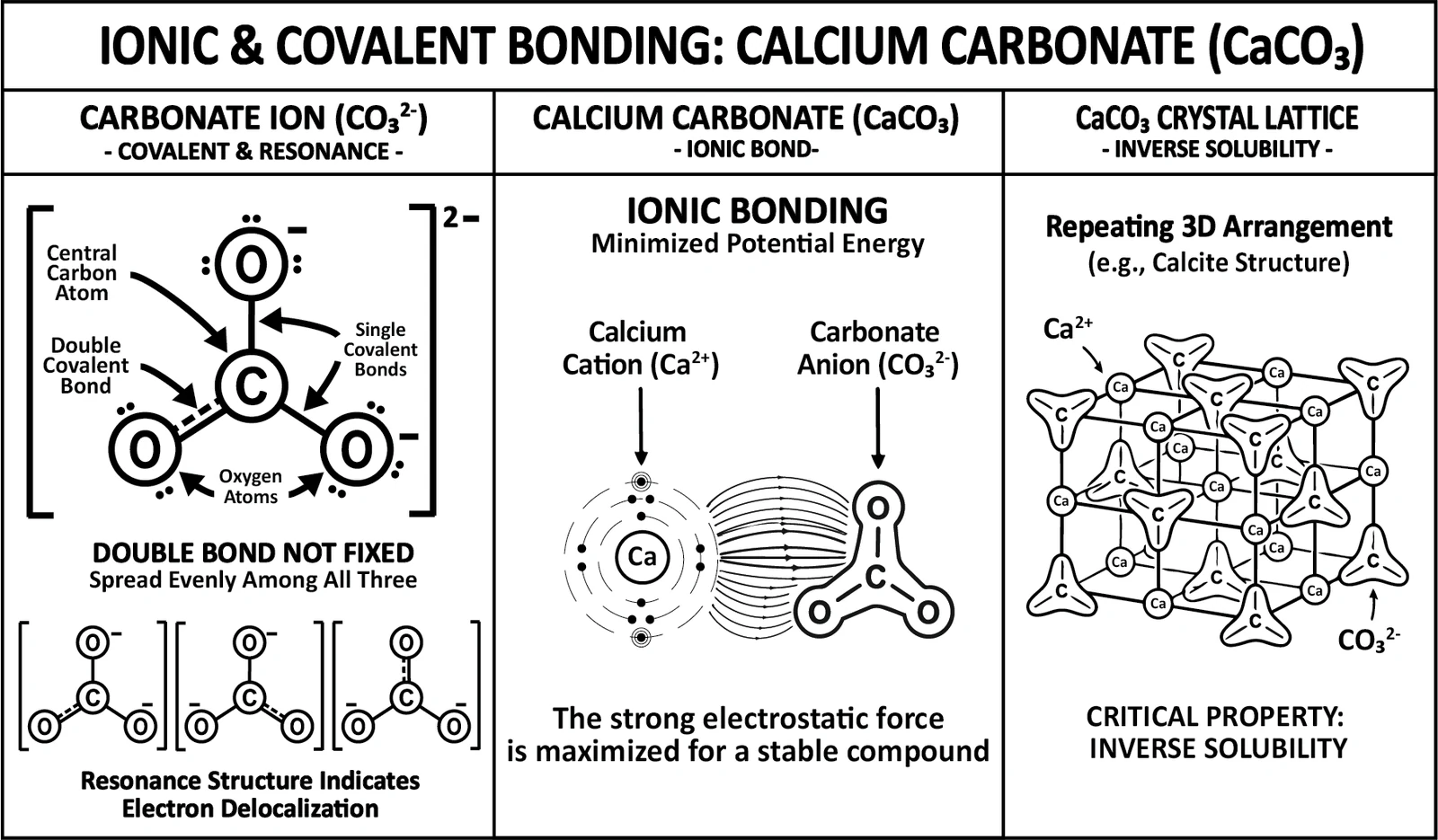
Calcium carbonate (CaCO₃) is one of the most important scale-formers in water treatment because it combines both types of bonding.
At its core is the carbonate ion (CO₃²⁻). Carbon sits at the center, bonded to three oxygen atoms through strong covalent bonds. The result is a rigid, symmetric structure. Internally stable and difficult to deform.
Despite this symmetry, the carbonate ion carries a net -2 charge. Covalent bonding holds it together. It does not neutralize it. Externally, carbonate behaves as a doubly charged anion, and that exposed charge is what makes it dangerous.
This is where calcium enters.
Calcium (Ca²⁺) is a small, highly charged cation with a strong electrostatic pull. When it encounters carbonate, the opposite charges attract powerfully, forming a strong ionic bond between the two species.
The result is a hybrid structure: covalent bonds lock the carbonate ion into a rigid shape; ionic attraction binds it tightly to calcium. Together, these interactions produce a dense, interlocking crystal lattice. Energetically stable and extraordinarily difficult to pull apart.
And this stability has consequences.
Most things dissolve better in hot water: sugar into coffee, table salt into a boiling pot. Calcium carbonate does the opposite. The hotter water gets, the less CaCO₃ it can hold. The mineral begins to fall out of solution as solid scale.
Think about where that leaves us. The scale forms worst exactly where the water is hottest: on the boiler tubes, the heat exchangers, the heated surfaces a facility depends on most. The one place you cannot afford an insulating crust is the one place chemistry is most determined to build it. This behavior is known as inverse solubility.
It is partly due to calcium carbonate’s structure, which makes it difficult for water to hold. It also involves temperature, carbonate equilibrium, and carbon dioxide behavior, which we will build on later. For now, remember the field result: heat pushes calcium carbonate towards scale.
1.8Building a Water Molecule
Up to this point, we have been laying rules.
Valence electrons dictate bonding.
Electronegativity determines how electrons are shared.
Geometry decides whether charge imbalance cancels, or if it survives.
Most molecules obey these rules quietly. Their internal tensions resolve themselves. Polarity may appear locally, but it disappears globally. Stability is achieved, and the story ends.
But water bends the rules.
Water is where they refuse to cancel.
Oxygen arrives with six valence electrons and a strong desire for two more. Hydrogen brings a single electron and is happy to share. Two hydrogens and one oxygen fit together neatly, forming two covalent bonds that satisfy all three atoms.
So far, nothing unusual.
As we’ve come to expect, the electrons are not shared equally between these two elements. Oxygen’s electronegativity is far greater than hydrogen’s, so the electrons are pulled closer to oxygen, creating a permanent charge imbalance: a partial negative charge near the oxygen atom and partial positive charges near the hydrogens.
On its own, that still isn’t special.
Most covalent molecules contain polar bonds. In many cases, the individual bond polarities cancel out due to highly symmetric shapes and the molecule is nonpolar. In other molecules, they do not cancel.
This is where water stands apart.
The oxygen atom carries not only the electrons shared in its two covalent bonds, but also two lone pairs of electrons. These lone pairs occupy space close to oxygen’s nucleus and strongly repel the bonding electrons associated with hydrogen. To minimize this repulsion, the molecule bends.
Instead of forming a straight line, water folds into a fixed, V-shaped structure, locking the hydrogens at an angle of about 104.5 degrees.
That shape matters. Tremendously.
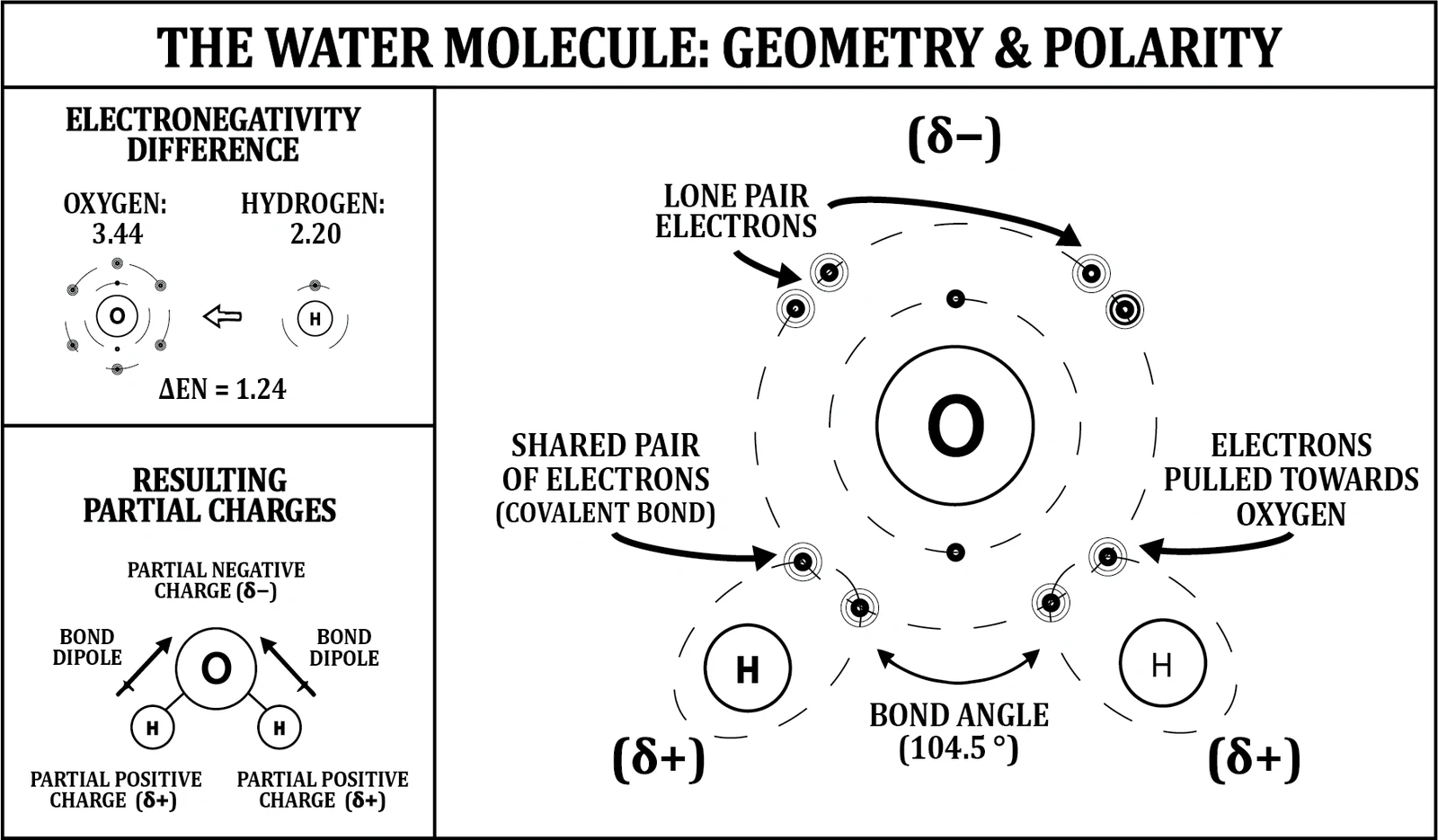
Because the charges are now separated in space, water becomes a polar molecule.
One side, near the hydrogen atoms, is always slightly positive.
The other side, near the oxygen atom, is always slightly negative.
This is not a temporary condition. It is not something that cancels out or disappears with motion. It is written into the geometry of the molecule itself.
It is asymmetric. It is polar. It carries stored electrical tension.
And that tension is not idle. A molecule with a slightly positive end and a slightly negative end is a molecule that grabs. The negative oxygen reaches for anything positive. The positive hydrogens reach for anything negative. This is the shape that dissolves rock, strips minerals from the earth, and surrounds every passenger waiting in that glass on my desk. A water molecule is a key that’s been cut to fit almost every lock in nature.
And yet, by itself, it does almost nothing.
It cannot wet a surface. It cannot dissolve a crystal. It cannot move heat or carve a river.
For that, it needs other water molecules.
1.9The Hydrogen-Bond Network
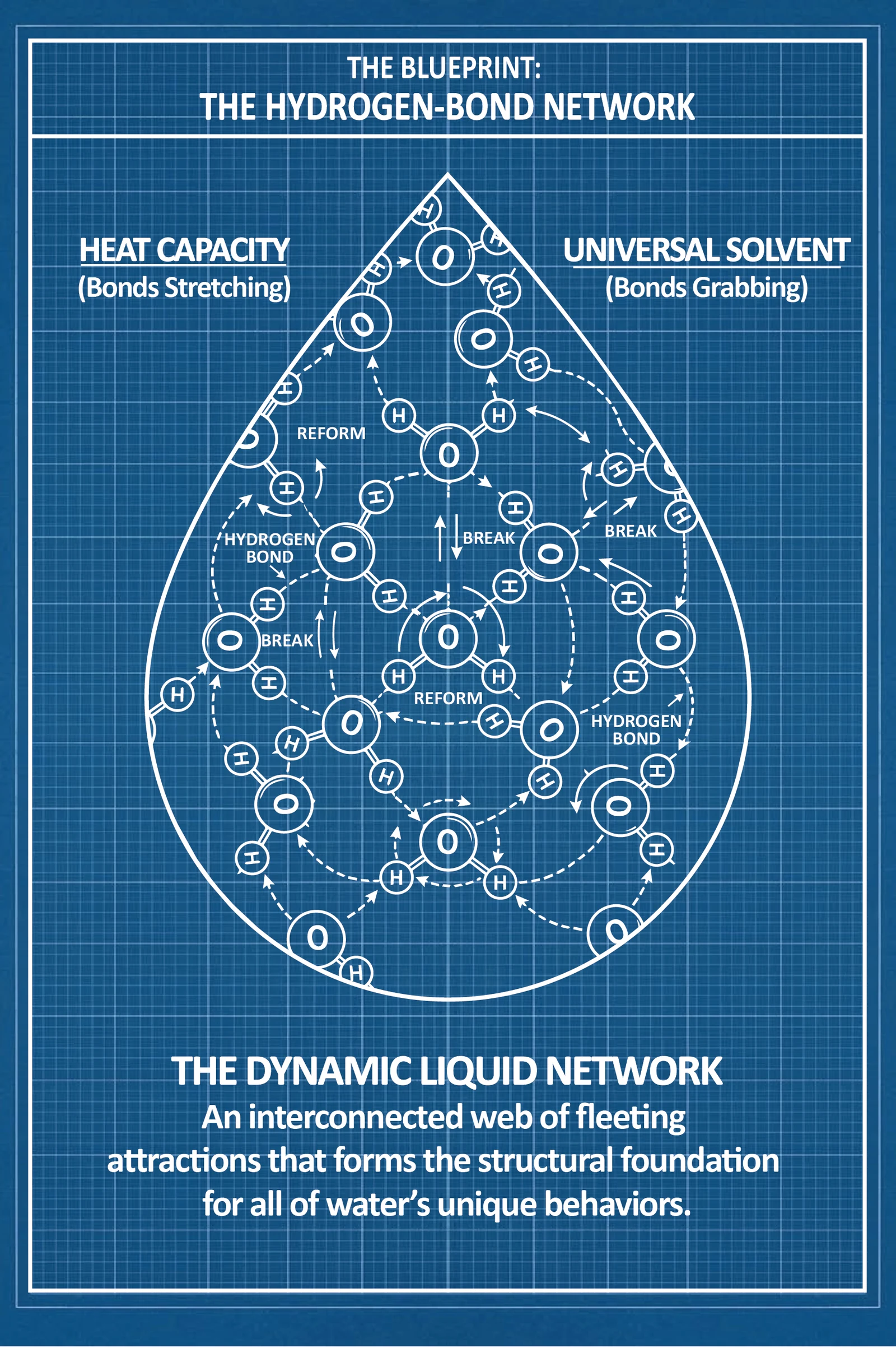
When the positive end of one water molecule meets the negative end of another, they stick. This attraction is called a hydrogen bond.
Hydrogen bonds are not true chemical bonds. They do not create new molecules. They are something looser: persistent intermolecular attractions, roughly one-tenth the strength of a covalent bond.
Individually, they are weak.
Collectively, they change everything.
Each water molecule can participate in up to four hydrogen bonds: two through its hydrogens and two through the lone electron pairs on its oxygen. In the eight-ounce glass on my desk, roughly 8 × 10²⁴ molecules participate in more than 10²⁵ hydrogen bonds at any given instant. Each constantly breaking, constantly reforming, and lasting less than a trillionth of a second.
No single bond survives. The structure they build persists.
This is the Hydrogen-Bond Network: a real, physical network that exists wherever liquid water exists. Working as a cohesive whole, the network moves energy. It stores heat without flinching, releases it slowly, and steadies abrupt changes before they can cause damage. This is precisely what makes water so valuable to industry.
But the network does not only serve us.
It dissolves minerals out of rock and carries them into our systems as scale. It carries oxygen from the air and delivers it to metal surfaces where corrosion begins. It hands microbial life the nutrients and warmth it needs to colonize.
The same network that makes water indispensable is the network that makes water treatment necessary.
This network is the blueprint.
Everything that follows – heat transfer, solubility, corrosion, scaling, life itself – flows from it.
We have built the machine. In the next chapter, we put it to work.
1.10Engineering Notes: Building Blocks
“If you are reading this straight through, you can skip this section and lose nothing essential to the story. These notes are for the operators, engineers, and technicians who need to do the math.”
Why This Matters in the Field
In industrial water treatment, calculation errors usually aren’t subtle, they’re order-of-magnitude errors. This section builds three habits that prevent them:
-
Reading the periodic table for behavior, not trivia
-
Converting between mass ⇄ moles ⇄ particles reliably
-
Using dimensional analysis to prevent unit-driven overdoses
Core Tools & Constants
| Constant | Value |
|---|---|
| Avogadro’s Number | 6.022 × 10²³ particles/mol |
| Water Molar Mass | 18.015 g/mol |
| Density of Water (room temp) | ≈ 1.00 g/mL |
| Water Density (field rule) | 8.34 lb/gal |
| 1 fl oz | 29.5735 mL |
| 1 gal | 3,785 mL |
| 1 lb | 453.6 g |
Core translator: Atomic mass (u) ↔ Molar mass (g/mol) (numerically equivalent)
Using the Periodic Table as a Tool
What the periodic table tells you
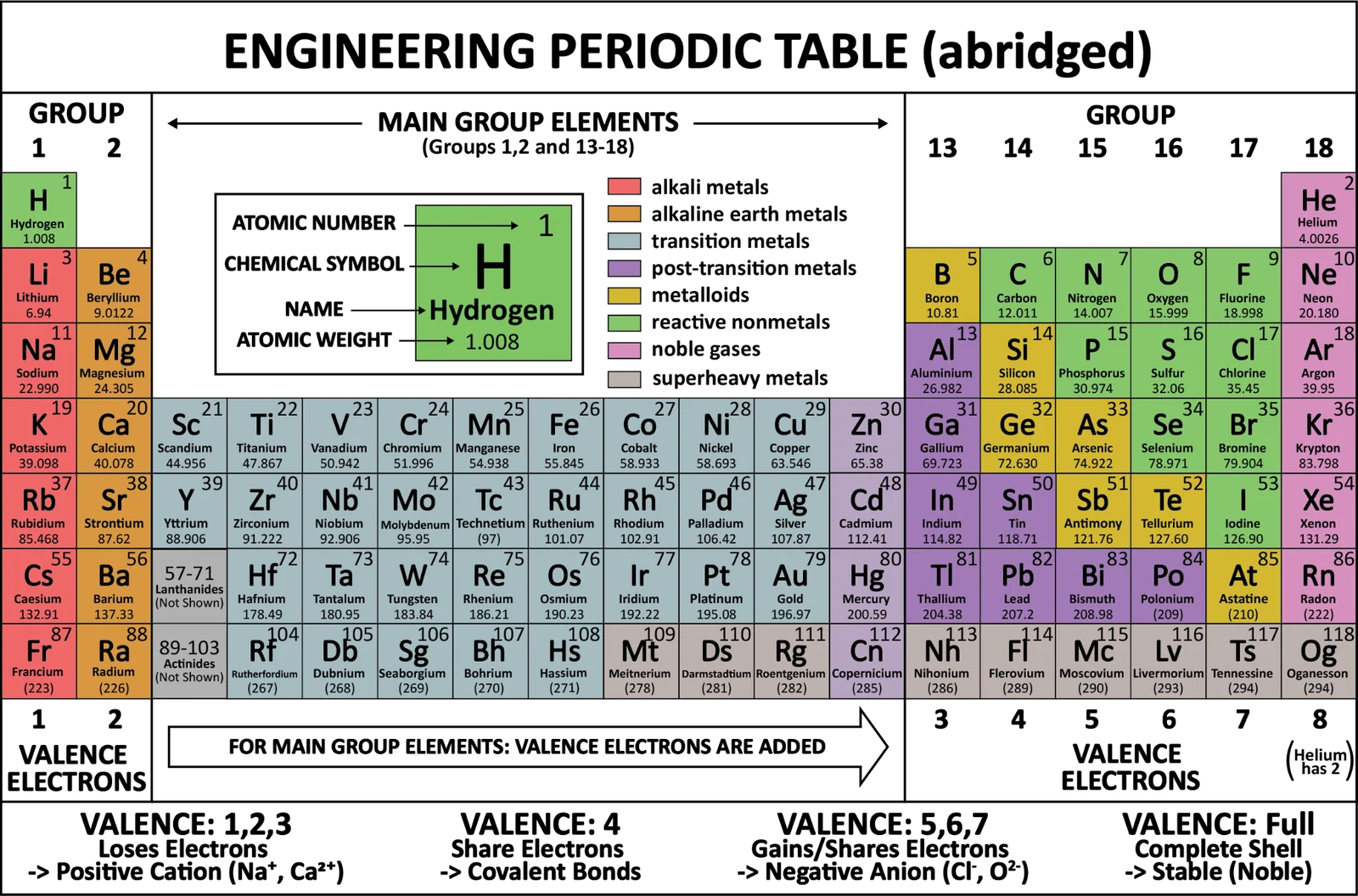
Each element box gives:
-
Name
-
Chemical Symbol
-
Atomic Number: Defines the element’s identity (number of protons)
-
Atomic Weight: Tells you how heavy a single atom is (weighted average)

Everything else (bonding behavior, ion charge, reactivity) flows from electron arrangement, especially valence electrons.
How the Table is Organized
Periods (Rows)
Each row represents the filling of a new electron shell. As you move left to right across a period:
-
Atomic number increases
-
Electrons are added to the same outer shell
-
Chemical behavior changes gradually and predictably
-
Noble Gases on the far right have full electron shells and are chemically inert
Groups (Columns)
Columns group elements with similar valence electron configurations. Because chemistry is driven by valence electrons, elements in the same column behave similarly:
-
They often form ions with the same charge
-
They participate in similar bonding patterns
-
They often exhibit similar solubility behavior in water
Valence Electrons: A Practical Rule of Thumb
For the main-group elements most relevant to water chemistry, you can generally predict the behavior by counting columns:
| Valence Electrons | Tendency | Resulting Ion | Examples |
|---|---|---|---|
| 1, 2, or 3 | Lose electrons | Positive (Cation) | Sodium (Na+), Calcium (Ca2+) |
| 4 | Often share electrons | Covalent Bonds | Carbon (C) |
| 5, 6, or 7 | Gain or Share | Negative (Anion) | Chlorine (Cl−), Oxygen (O2−) |
| Full Outer Shell | Do nothing | Stable | Helium, Neon |
Note: Hydrogen and Helium are exceptions. Instead of an octet, they follow a “duet rule,” meaning they become chemically stable when their single shell is completely full with two electrons.
\
Atomic Mass and Atomic Weight
Atomic mass is the summation of an atom’s constituent particles. Nearly all of that mass resides in the nucleus. Electrons contribute almost nothing by comparison, about 1/1,836 the mass of a proton.
For practical purposes:
Atomic mass is measured in atomic mass units (u).
Just as the gram was proposed as the mass of one cubic centimeter of water, and the pound as some weird number of cereal grains, the atomic mass unit (u) required a reference point. Scientists chose the isotope Carbon-12 as the basis. A Carbon-12 atom contains:
-
6 protons
-
6 neutrons
-
6 electrons (negligible contribution)
Therefore, its atomic mass is exactly 12 u.
All other atomic masses are measured relative to this standard. Hydrogen, with just one proton, has an atomic mass of 1 u.
Atomic mass is the mass of a single atom.
Atomic weight is the weighted average of all naturally occurring isotopes of an element, accounting for their relative abundance on Earth. Because most elements exist as a stable mixture of isotopes in predictable proportions, atomic weight is effectively a fixed constant for practical purposes.
In field calculations, the difference between the two is negligible. Oxygen’s atomic weight is 15.999 rather than exactly 16, but no water treatment calculation turns on that distinction.
This book uses the terms interchangeably, as does most of the technical literature you will encounter in practice. When precision matters at the isotopic level, you will know you are in a different discipline entirely.
The Mole: Bridging Two Worlds
Knowing the mass of a single atom is interesting, but not very useful on its own. We don’t work with individual atoms. We work with grams, liters, and gallons.
To bridge this gap, chemistry relies on a translator: the mole.
Avogadro’s Number
A mole is simply a specific quantity of particles, originally determined by the number of atoms in exactly 12 grams of Carbon-12.
It is defined by Avogadro’s Number:
This constant connects the microscopic and macroscopic worlds. It allows us to translate:
Mass ⇄ Moles ⇄ Particles
Where ‘elementary entities’ can refer to atoms, molecules or ions.
It also determines an important relation: an element’s atomic mass (u) is equal to its molar mass (grams/mole).
-
1 mole of hydrogen atoms weighs approximately 1.008 gram
-
1 mole of oxygen atoms weighs approximately 15.999 grams
Different masses, but the same number of atoms in each case.
A Simple Reaction: Why Moles Matter
Chemical reactions happen between atoms, not grams. And the macroscopic world of grams, pounds, liters, and gallons is inconsistent. The same mass of different elements contain vastly different numbers of atoms.
Consider this simplified example: sodium reacting with chlorine to form sodium chloride.
Note: In the real world, elemental chlorine normally exists as Cl₂ gas, not as isolated chlorine atoms. The balanced reaction is: 2Na + Cl₂ → 2NaCl
For this calculation, we are going to count chlorine one atom at a time. That lets us focus on the main point: atoms react in fixed numerical ratios, while grams do not.
Atomic mass (Cl) = 35.45 u → Molar mass (Cl) = 35.45 grams/mol
5 grams ÷ 35.45 grams/mole = 0.141 moles of chlorine
Note: 0.141 moles of chlorine × 6.022 × 1023 = 8.49 × 10²² chlorine atoms
Sodium reacts with chlorine in a 1:1 atomic ratio to form sodium chloride. One sodium atom pairs with one chlorine atom to form one formula unit of NaCl.
So, if we have 0.141 moles of chlorine atoms, we need exactly 0.141 moles of sodium atoms.
Equal moles means equal numbers of atoms.
Atomic mass (Na) = 22.99 u → Molar mass (Na) = 22.99 g/mol
0.141 moles × 22.99 grams/mole = 3.24 grams of sodium
Even though they react one-to-one, we need less mass of sodium because chlorine atoms are heavier than sodium atoms. Therefore, the same mass (in grams) of sodium will contain more atoms.
Atomic mass (Na) = 22.99 u → Molar mass = 22.99 g/mol
5 grams ÷ 22.99 grams/mole = 0.217 moles of sodium
0.217 moles of sodium × 6.022 × 1023 = 1.31 × 10²³ sodium atoms
If we added the reactants based on grams, we’d have 1.54x more sodium atoms available. By adding only 3.24 grams of sodium, we’ve achieved a perfect stoichiometric reaction and produced 0.141 moles of NaCl as the product.
Formula mass (NaCl) = 22.99 u + 35.45 u = 58.44 u = 58.44 grams/mole
0.141 moles × 58.44 grams/mole = 8.24 grams of sodium chloride
The total mass of the reactants (5 grams of chlorine + 3.24 grams of sodium) equals the mass of the product (8.24 grams of sodium chloride). Our math maintains the “Law of Conservation of Math” (phew).
Dimensional Analysis
If I could instill one habit in every water treater, it would be dimensional analysis. It is nothing more than disciplined unit conversion, but skipping it is how people end up ten-times overdosing a system.
It takes a minute and a piece of paper, but it will save your butt.
Here’s how it works.
The Goal: Calculate the number of molecules and hydrogen bonds in an 8-ounce glass of water using dimensional analysis.
Use the conversion factor : 1 fl ounce = 29.5735 mL.
8 fl ounces × = 236.588 mL
Note how the starting unit (fl ounces) cancels with the denominator (fl ounces). Conversion factors can be flipped to make sure they cancel, and this lets you check.
At room temperature, the density of water is effectively 1.00 g/mL .
236.588 mL × = 236.588 g
The mL cancel out and we’re left with mass, which means we can enter the chemical world.
First, determine the Molar Mass of water (H2O):
Hydrogen = 1.008 u → 1.008 g/mol
Oxygen = 15.999 u → 15.999 g/mol
[2 × (1.008 g/mol)] + [1 × (15.999 g/mol)] = 18.015 g/mol
Now divide the grams of water by its molar mass:
🡪 236.588 g × = 13.13 mol
Again, this is why dimensional analysis is so critical, to make sure you’re ending up in the correct units. Dividing by g/mol cancels out the grams and moves mol to the top (the numerator). This is the same as multiplying by the mol/g. They are different methods of ensuring that units cancel.
Plug in Avogadro’s Number, to convert our world into atoms:
13.13 mol × = 7.91 × 1024 molecules of H2O
That is roughly 8 septillion molecules in a single glass. It’s pretty cool to be able to derive that, and even cooler to check your work with dimensional analysis. Skipping this simple process of checking units is how you end up very confident, but very wrong.
In liquid water, the number of hydrogen bonds per molecule is not a fixed number, as bonds are constantly breaking and reforming. A water molecule can form a maximum of four hydrogen bonds. On average, a water molecule in liquid water at room temperature forms approximately 3.4 hydrogen bonds.
The total number of hydrogen bonds (NHB) is the number of water molecules multiplied by the average number of hydrogen bonds per molecule. When counting the total bonds between the molecules, we must divide by two to avoid double-counting each bond (as each bond is shared between two molecules):
Let N = molecules, b = average hydrogen bonds per molecule.
Total Number of Hydrogen Bonds:
NHB = N × b ÷ 2
Using N = 7.91 × 1024 molecules, and b = 3.4 bonds/molecule:
NHB ≈ (7.91 × 1024) × (3.4) ÷ 2 = 1.34 × 1025 Hydrogen Bonds
This is an extraordinarily huge number, representing the average hydrogen bonds at a given moment, for water at room temperature. As the temperature rises, the number of bonds decreases as molecular motion shakes them apart. As we approach the freezing point of water, the number of bonds approaches 4, with each molecule locked in a rigid tetrahedral framework.
The resulting Hydrogen-Bond Network is a remarkable display of chemical interaction that enables the endlessly fascinating properties of water.